|
The Center for the Biology of Nematode Parasitism exploits opportunities in post-genomic biology.
This Center integrates knowledge and research of free-living and parasitic nematodes and exploits model systems to make strides in understanding the basic mechanism of parasitism.
|


| Error: It's not possible to reach RSS file... |
|
 |
|
|
|
Meloidogyne hapla sequenced, mapped
The research could help lead to a new generation of eco-friendly tools to manage the ubiquitous parasitic worm, which, along with other species of root-knot nematode, causes an estimated $50 billion in crop and plant damage yearly... read the NCSU press release.

Root-knot nematodes, stained red, move through a plant root.
Sequence and genetic map of Meloidogyne hapla: A compact nematode genome for plant parasitism
PNAS 2008 105:7
www.hapla.org
The Center's Roots
The face of parasite biology was forever changed in 1998. The complete genomic sequence of Caenorhabditis elegans was obtained.
It has provided a molecular guide to the obligate biotrophic parasitic nematodes.
Nematodes are the world's most important and ubiquitous multi-cellular parasites, attacking humans, domesticated animals and cultivated crops.
They cause untold levels of economic damage and suffering worldwide and are responsible for many severe human diseases that afflict up to half of the world's population.
Because most important parasitic nematodes are obligate internal parasites, it has, until recently, been very difficult to study their biology and life cycles.
The sequencing of the C. elegans genome, coupled with the wealth of biological information it revealed, has placed parasite nematologists in a unique and powerful position. As never before, it is possible to make inroads into the basic biology of nematode parasites.
The Center for the Biology of Nematode Parasitism stands poised to exploit these opportunities in post-genomic biology. A major goal of this group is to integrate knowledge and research of free-living and parasitic nematodes and to exploit model systems to make strides in understanding the basic mechanism of parasitism.
The experiments and research agendas we are pursuing would have been unthinkable several years ago. The vast complexity of parasite biology, combined with the massive effort necessary to explore basic biological mechanisms across species, demands the scope and scale that only a Center environment can supply.
|
|
|
|
|
|
|
|
|
|
|
|
|


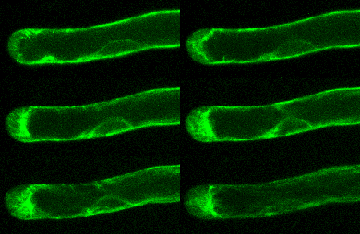
Comprehensive Transcriptome Profiling in Tomato Reveals a Role for Glycosyltransferase in Mi-Mediated Nematode Resistance Plant Physiology 144:1079-1092 (2007)
Jennifer E. Schaff, Dahlia M. Nielsen, Chris P. Smith, Elizabeth H. Scholl and David McK. Bird
Phylogenetic Analysis of Pasteuria penetrans by Use of Multiple Genetic Loci Journal of Bacteriology, August 2005, p. 5700-5708, Vol. 187, No. 16
Lauren Charles, Ignazio Carbone, Keith G. Davies, David Bird, Mark Burke, Brian R. Kerry, and Charles H. Opperman
Root-knot nematodes and bacterial Nod factors elicit common signal transduction events in Lotus japonicus PNAS | February 22, 2005 | vol. 102 | no. 8 | 3147-3152
Ravisha R. Weerasinghe, David McK. Bird and Nina S. Allen
Virulence Genes in Heterodera glycines: Allele Frequencies and Ror Gene Groups Among Field Isolates and Inbred Lines (pdf file)
Phytopathology | February 2005 | Volume 95, Number 2
K. Dong, K. R. Barker, and C. H. Opperman. Pages 186-191.
Lotus japonicus: A New Model to Study Root-Parasitic Nematodes
Dasharath Prasad Lohar and David McK. Bird
Plant and Cell Physiology, 2003, Vol. 44, No. 11 1176-1184
Horizontally transferred genes in plant-parasitic nematodes: a high-throughput genomic approach
Elizabeth H Scholl, Jeffrey L Thorne, James P McCarter, and David Mck Bird
Genome Biology 2003, Vol. 4, Issue 6
Cytokinins play opposite roles in lateral root formation, and nematode and Rhizobial symbioses
Lohar, Dasharath Prasad, Schaff, Jennifer E., Laskey, James G., Kieber, Joseph J., Bilyeu, Kristin D., Bird, David McK.
The Plant Journal 38 (2), 203-214. (2004)
Model systems in agriculture: Lessons from worms.
Bird, David McK.
Annals of Applied Biology 146 (2), 147-154. (2005)
Resolving tylenchid evolutionary relationships through multiple gene analysis derived from EST data
Elizabeth H. Scholl and David McK. Bird
In Press, Corrected Proof, Available online 3 May 2005
Plant Parasitic Nematodes: Habitats, Hormones, and Horizontally-Acquired Genes
David McKenzie Bird, Hinanit Koltai
Journal of Plant Growth Regulation, Volume 19, Issue 2, Jun 2000, Pages 183 - 194
Alkahest NuclearBLAST : a user-friendly BLAST management and analysis system
Diener SE, Houfek TD, Kalat SE, Windham DE, Burke M, Opperman C, Dean RA
BMC Bioinformatics 2005, 6:147 (15 June 2005)
Wormbase
Nematode.Net
DNA Analysis
Entrez
Blaxter Lab
C. Elegans WWW server
Agriculture Network Information Center
Genome Research Laboratory
|

|